
What Is DPSCS?
DPSCS is the official abbreviation used by the Maryland Department of Public Safety and Correctional Services. Maryland does not brand the statewide agency as a simple standalone "MDOC." DPSCS is the umbrella state agency that includes the Division of Correction, the Division of Pretrial Detention and Services, the Division of Parole and Probation, the Maryland Parole Commission, Patuxent Institution, and the Maryland Commission on Correctional Standards. That structure matters for a DPSCS inmate population search because the same agency runs state prisons and also operates major Baltimore City detention functions.
The Division of Correction is the prison side of DPSCS. The agency describes that correctional operation as covering all Maryland state prisons and a mission of public safety, incarceration of sentenced individuals, programming, reentry, victim services, Maryland Correctional Enterprises, and Public Safety Works. The statewide DPSCS inmate population is therefore not the same as a single county jail list. A person newly arrested in Allegany, Montgomery, Prince George's, Wicomico, or another county may still be in a local detention center. A person booked in Baltimore City may be in a state-operated pretrial facility. A sentenced state prisoner is the clearest fit for the DPSCS inmate locator.
The DPSCS Division of Correction page describes the state prison mission and correctional operations.
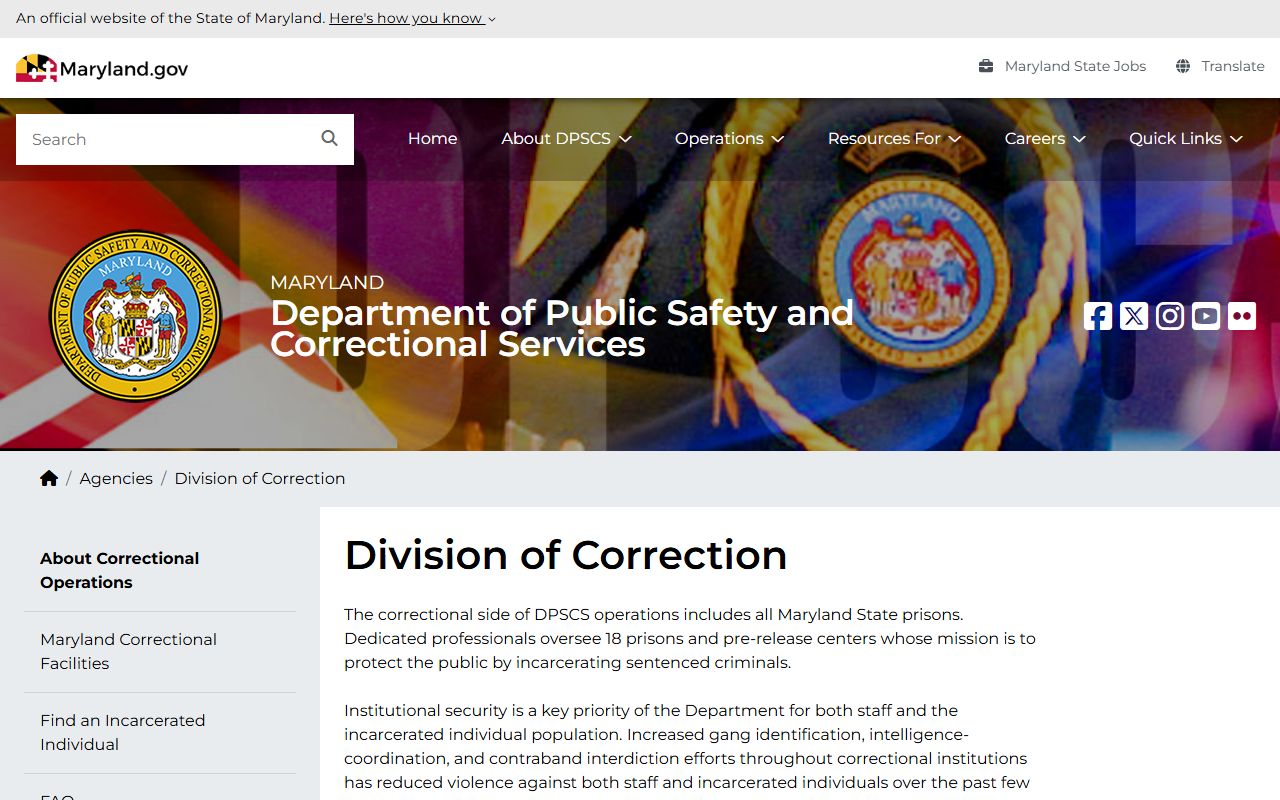
This state page supports the DPSCS inmate population topic because it separates sentenced state prison custody from local jail roster searches.
The DPSCS Inmate Population
The strongest current population statement from the research is an average daily population, not a live count. DPSCS reported a FY 2025 average daily incarcerated-individual population of 15,686 in the official Average Daily Population report. The February 2026 Department of Legislative Services budget overview adds the trend context: the sentenced population declined about 19 percent from FY 2016 to FY 2025, increased about 1 percent from FY 2024 to FY 2025, and showed a 5 percent decline in the second quarter of FY 2026 compared with FY 2025. That means the Maryland state-prison count remains far below its FY 2016 level, even though the most recent annual movement was not a straight decline.
| Measure | Figure | Source / date |
|---|---|---|
| DPSCS inmate population | 15,686 average daily population | DPSCS FY 2025 ADP report |
| Long-term sentenced-population trend | About 19% decline from FY 2016 to FY 2025 | DLS FY 2027 budget overview, February 2026 |
| Recent annual movement | About 1% increase from FY 2024 to FY 2025 | DLS FY 2027 budget overview |
| Facility framing | 18 prisons and pre-release centers; facility locator lists 13 correctional and five detention facilities | DPSCS correctional operations and facility locator |
The DPSCS Average Daily Population report index is the official starting point for annual Maryland prison population reports.
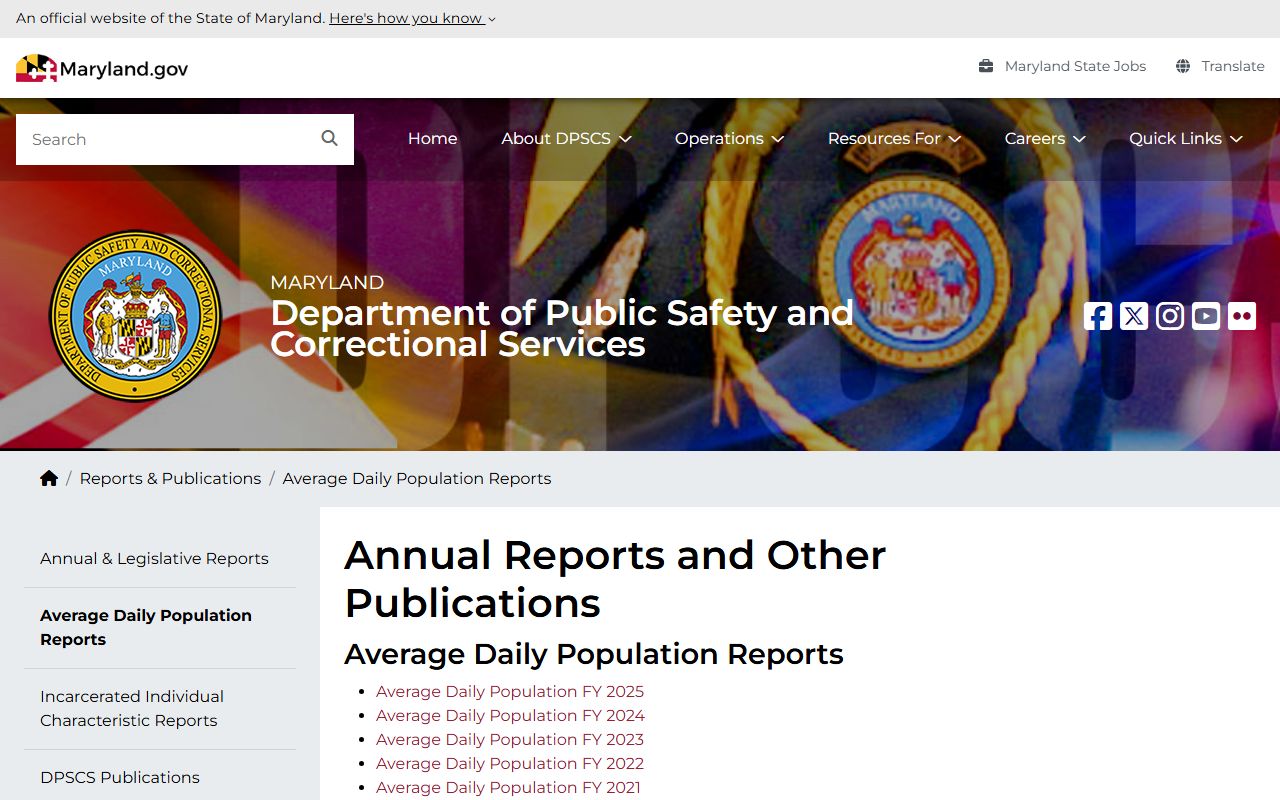
The report index is better for dated statewide figures than a daily lookup page, because it identifies the population metric and fiscal year.
DPSCS Inmate Locator Search
The official DPSCS inmate locator is the Incarcerated Individual Locator. The form is name based. It has first-name and last-name fields, with validation that prevents both fields from being blank. The locator covers incarcerated individuals committed to the custody of the Commissioner of Correction and housed at Division of Correction facilities, Patuxent Institution, and some short-sentenced people at Division of Pretrial and Detention Services facilities. DPSCS also states that the locator does not provide information on everyone in DPSCS custody and does not list people no longer in custody because of release, escape, or another reason.
- Start with the legal last name. Add a first name when the last name is common or the spelling is reliable.
- Use the DPSCS inmate locator when the person may be sentenced to Maryland state custody or committed to the Commissioner of Correction.
- If the person was arrested today or yesterday, check the county jail path, VINE, and Maryland Judiciary Case Search before assuming DPSCS has the record.
- For Baltimore City detention, compare the DPSCS locator with court records and VINE because some pretrial facilities are state-operated.
- If no result appears, test other official channels. The person may be in county, federal, ICE, juvenile, released, or out-of-state custody.
The DPSCS Incarcerated Individual Locator shows the form and the official custody-scope language.
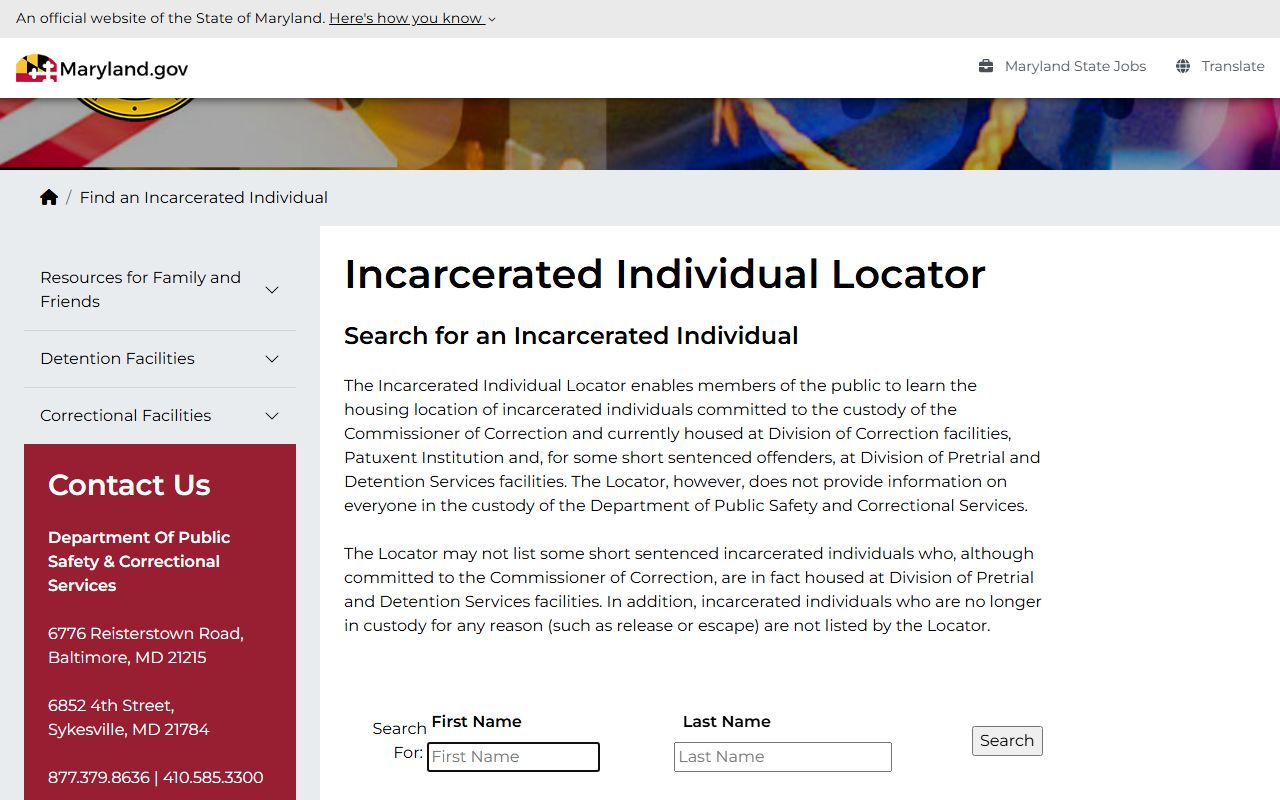
The search form supports first-name and last-name searching, so common names should be checked against court and county records before a result is treated as final.
DPSCS Inmate Record Fields
The research supports a narrow description of the DPSCS result. It is a housing-location locator for covered current custody, not a criminal-history report, mugshot gallery, sentence-calculation tool, or complete case file. Maryland court dates, filed charges, dispositions, bond conditions, prosecutor filings, expungement, and shielding status belong in Maryland Judiciary Case Search or clerk records. State correctional case files can also have disclosure limits under Correctional Services section 3-602 and investigatory-record limits under the Maryland Public Information Act.
| Field or issue | How to read it |
|---|---|
| Name search | The DPSCS form uses first and last name rather than booking number, DOC ID, county, date of birth, or charge filters. |
| Housing location | A result points to covered current custody and should be treated as a location record, not the whole criminal case. |
| Current custody only | Released people and some people not covered by the locator scope may not appear. |
| Court charges | Use Maryland Judiciary Case Search and clerk records for filed charges, hearing dates, disposition, and case number. |
| Records request | Use the DPSCS PIA process for DPSCS-held records, subject to exemptions and case-record limits. |
Important: A missing DPSCS locator result is not proof that the person is out of custody.
DPSCS Prisons and Facilities
DPSCS uses more than one facility category. The correctional operations page describes 18 prisons and pre-release centers. The current facility locator separately lists five detention facilities and 13 correctional facilities. Detention listings include Baltimore Central Booking and Intake Center, Chesapeake Detention Facility, Maryland Reception, Diagnostic and Classification Center, Metropolitan Transition Center, and Youth Detention Center. Correctional listings include Baltimore City Correctional Center, Central Maryland Correctional Facility, Dorsey Run, Eastern, Jessup, MCI-Hagerstown, MCI-Jessup, MCI-Women, Maryland Correctional Training Center, North Branch, Patuxent, Roxbury, and Western.
Security and mission vary by institution. North Branch and Western are maximum-security prisons in Allegany County. Eastern Correctional Institution is medium with an annex described in local research as minimum and pre-release. The Hagerstown area has MCI-Hagerstown, Maryland Correctional Training Center, and Roxbury Correctional Institution, which are separate facilities. Jessup-area facilities include Jessup Correctional Institution, Maryland Correctional Institution - Jessup, Maryland Correctional Institution - Women, Dorsey Run Correctional Facility, and Patuxent Institution. MRDCC handles reception, diagnostic, and classification work for newly sentenced prisoners.
The DPSCS facility locator separates Maryland detention facilities from correctional facilities.
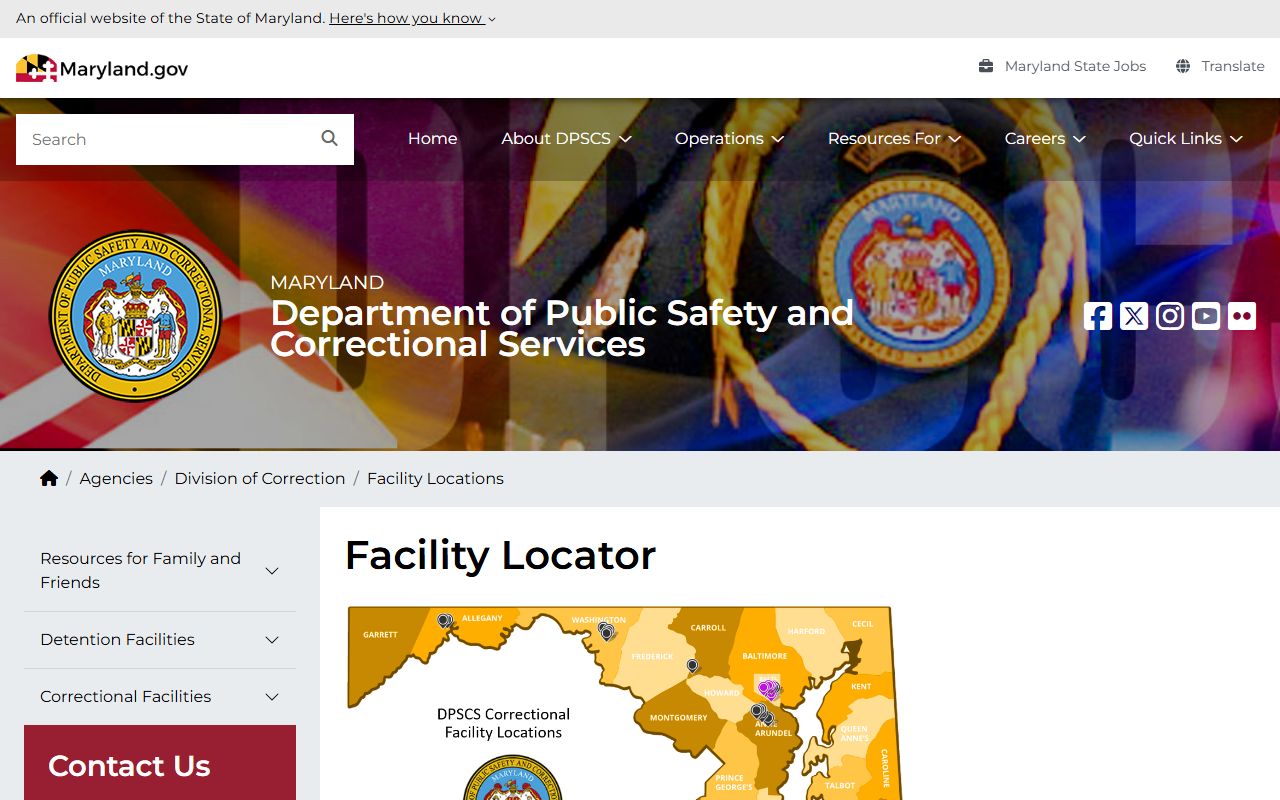
This facility list is the source that prevents the DPSCS inmate population page from collapsing distinct Baltimore, Jessup, Hagerstown, and Cumberland institutions into one generic prison entry.
The statewide Maryland detention facility directory includes county jails, state prisons, federal custody, juvenile secure facilities, and community corrections entries where the research mapped them.
DPSCS Sentencing and Release
Maryland custody usually starts locally. A police agency, sheriff, or state police barrack makes an arrest, and a District Court commissioner or court handles the early release decision. After conviction and sentencing, a person may serve a local jail sentence or enter DPSCS custody. The exact transfer path depends on sentence length, custody authority, medical or security classification, holds, transport, and agency decisions. Several county research files describe local detention centers that hold pretrial detainees and short local sentences, while longer terms usually move into state custody.
Maryland good-time and diminution-credit rules are statutory. Correctional Services section 3-702 gives eligible incarcerated individuals committed to the Commissioner a right to diminution credits under the subtitle. Section 3-704 sets the main good-conduct credit rule at 10 days per calendar month in general, or 5 days per calendar month for listed crimes of violence or certain controlled-dangerous-substance sentences. Periods such as escape, sentence stays, or parole-revocation decisions can affect credit. Parole is a separate decision by the Maryland Parole Commission for eligible people serving sentences of six months or more.
| Term | Meaning in Maryland custody |
|---|---|
| Diminution credit | Statutory credit that may reduce the time served before mandatory supervision or release. |
| Parole | Conditional release decided by the Maryland Parole Commission, with supervision terms. |
| Mandatory supervision | Supervised release after credit calculations reduce the remaining term, subject to law and agency rules. |
| Detainer | A hold or notice from another authority that can affect release or transfer. |
DPSCS or County Jail
The DPSCS inmate population is not the full Maryland inmate population. A county jail roster is the better starting point for a new local arrest, a pretrial detainee, or a short local sentence. DPSCS is the better starting point for sentenced state custody and some covered short-sentenced or Baltimore detention cases. Federal BOP is the source for federal prisoners, ICE ODLS is the source for immigration detention, and Maryland Judiciary Case Search is the source for court charges after arrest.
| Custody type | Primary source | What it answers |
|---|---|---|
| Sentenced Maryland state custody | DPSCS Incarcerated Individual Locator | Covered current housing location in state custody. |
| New county arrest or pretrial custody | County jail roster, VINE, or local records route | Local booking and custody status when available. |
| Federal custody | BOP Inmate Locator | National federal prisoner records from 1982 to present. |
| Immigration detention | ICE Online Detainee Locator System | Custody status by A-number or biographical search. |
| Court case after arrest | Maryland Judiciary Case Search | Charges, case number, hearing dates, and disposition when public. |
DPSCS Records Requests
DPSCS records requests use the Maryland Public Information Act process through the agency that holds the record. The DPSCS PIA page states that it handles DPSCS records and does not manage records requests for courts, police departments, local detention centers, prosecutors, or other agencies. The page identifies the Public Information Act Coordinator Office of Constituent Services at 6776 Reisterstown Road, Suite 212, Baltimore, MD 21215, and gives the email dpscs.pia@maryland.gov. It also links a fillable MPIA request application and explains that requests limited to one DPSCS agency or program should go to that agency's Director's Office.
Maryland Public Information Act rules still include limits. General Provisions section 4-203 requires prompt action and generally no more than 30 days to grant or deny a request, with a delay notice if more than 10 working days are needed. Section 4-206 addresses reasonable fees and the first two hours of search and preparation time. DPSCS says privileged or exempt records may be withheld, including attorney-client material, attorney work product, some incarcerated individual case records, medical records, personnel records, financial information, investigatory records, and internal memoranda. PIA covers existing records, not a demand that an agency create a new list or report.
The DPSCS Public Information Act page is the state route for DPSCS records, forms, fee limits, and custodian guidance.
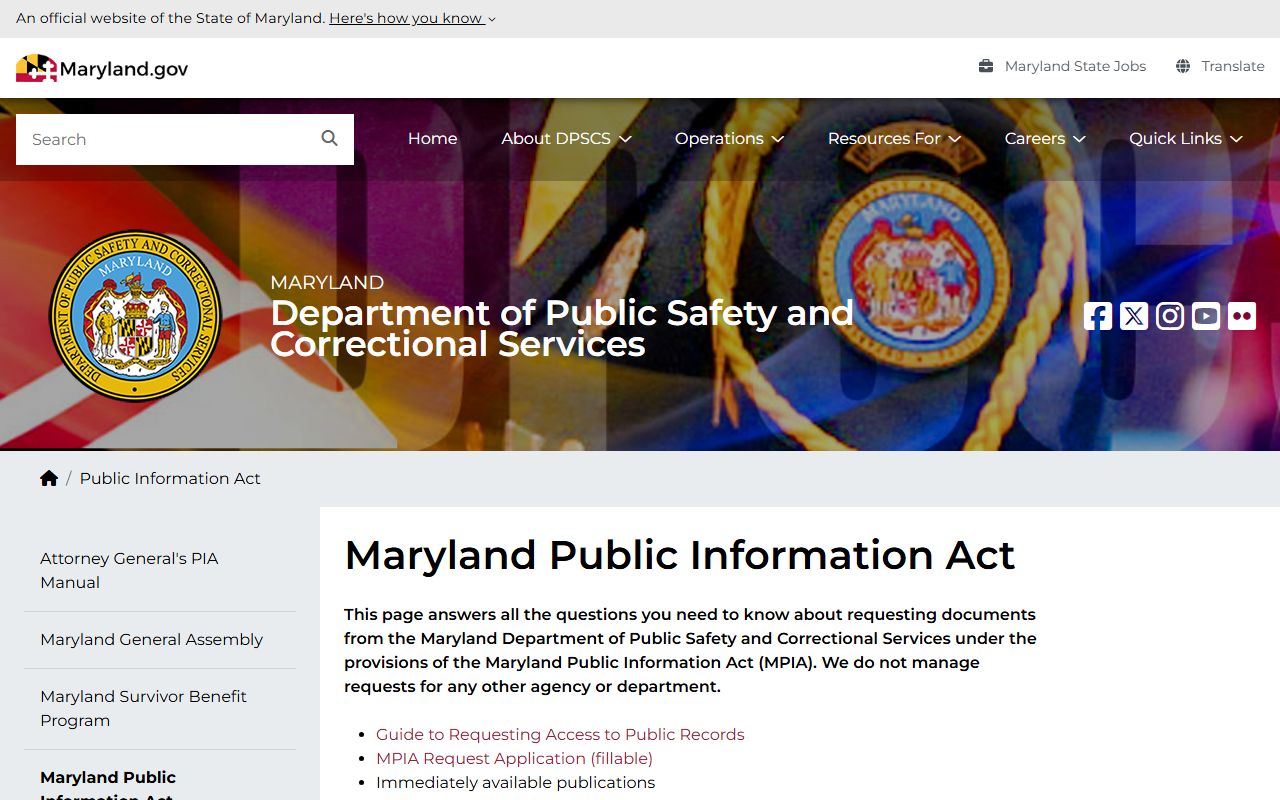
This route belongs on the DPSCS page because county jail, court, police, and prosecutor records must still be requested from their own custodians.
DPSCS Inmate Population FAQ
How large is the DPSCS inmate population?
DPSCS reported an average daily incarcerated-individual population of 15,686 for FY 2025. That is a dated annual metric, not a live headcount. The population can change day to day because of commitments, releases, transfers, parole, mandatory supervision, court movement, hospital movement, and reentry placement.
Does the DPSCS locator cover county jails?
No. The locator is for covered state custody, including people committed to the Commissioner of Correction and housed in Division of Correction facilities, Patuxent Institution, and some short-sentenced people in Division of Pretrial and Detention Services facilities. Use the Maryland county directory for local jail routing.
Why does Baltimore City differ?
Baltimore City has major state-operated pretrial and detention facilities. That makes Maryland different from many states where a county sheriff runs every local jail. For a Baltimore City search, compare DPSCS, VINE, and court records instead of assuming one source has every current detail.
Public Record Search
Sponsored Results